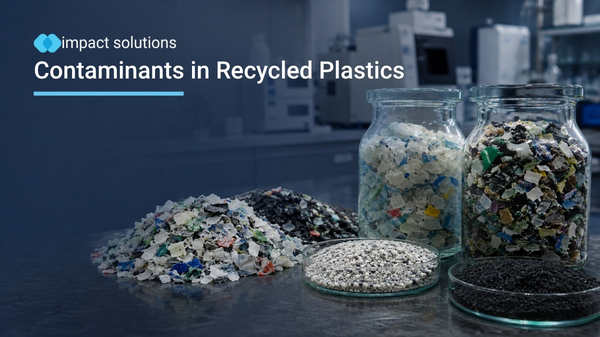
Using recycled plastics can help manufacturers reduce their reliance on virgin raw materials and support more circular approaches to product development. But introducing recycled content can also introduce greater variability into the material supply chain.
One important consideration is the potential presence of contaminants in recycled plastics.
Unlike virgin polymer produced from a controlled formulation, recycled plastic has already had a previous life. Its history may include additives from its original manufacture, exposure to other substances during use, contamination during waste collection or changes caused by ageing and repeated processing.
For manufacturers, understanding what is present in recycled material can be just as important as knowing how much recycled content it contains.
Where do contaminants in recycled plastics come from?
Plastic waste can pass through numerous environments before it becomes a new raw material.
The European Commission identifies several potential sources of chemical contamination in recycled plastics, including substances originating during the plastic’s original manufacture, previous use, misuse and cross-contamination during waste collection.
For example, packaging may previously have held cleaning products, chemicals or other substances. Different plastics can also become mixed during collection and sorting, while contact with other waste streams can introduce additional contamination.
This means two batches of recycled polymer with the same basic description can have quite different chemical histories.
Legacy additives can remain in the recycling stream
Not every unexpected substance in recycled plastic is necessarily contamination in the traditional sense.
Some chemicals may have been deliberately added when the original product was manufactured.
Plastics can contain additives including:
- Plasticisers
- Flame retardants
- Pigments
- UV stabilisers
- Antioxidants
- Processing aids
- Fillers
These substances may have been necessary for the material’s original application. However, when that material is recycled into a new product, the same additive package may no longer be appropriate.
This is particularly relevant when recycling older products. Materials manufactured many years ago may contain substances that are now restricted, controlled or undesirable for certain modern applications.
This creates a challenge for manufacturers: the base polymer may be suitable for reuse, while its chemical history may require closer investigation.
Mixed waste streams can create unexpected material combinations
Contamination does not always involve a hazardous chemical. Sometimes the problem is simply the wrong plastic.
A recycled polypropylene stream, for example, may contain small quantities of polyethylene or another polymer because of imperfect sorting.
Even relatively low levels of another material can influence processing behaviour or finished-product properties, depending on the polymers and application involved.
Pigments, fillers and fibres can create further variation between batches.
The result can be material that broadly meets a description such as “recycled PP” or “recycled PE”, but behaves differently during extrusion, injection moulding or subsequent use.
Understanding recycled plastic quality therefore often requires looking beyond the polymer name alone.
Processing can create new chemical changes
A recycled polymer has already experienced at least one manufacturing and service-life cycle.
Heat, oxygen, UV exposure and chemical contact can alter polymers and their additives over time. The additional heat and shear involved in recycling may introduce further changes.
This can contribute to:
- Polymer degradation
- Changes in molecular weight
- Additive depletion
- Formation of degradation products
- Changes in colour or odour
- Reduced mechanical performance
Repeated recycling does not automatically make a plastic unsuitable. However, knowing the processing and ageing history can help explain why recycled materials sometimes behave differently from virgin equivalents.
Which contaminants should manufacturers be looking for?
There is no single list that applies to every recycled plastic.
What matters depends on the source of the recyclate, the original application and where the material will be used next.
For some applications, manufacturers may need to investigate the presence or concentration of substances such as:
Heavy metals: Metals can originate from pigments, stabilisers, fillers, contamination or components associated with the original product.
Brominated compounds: These may be associated with flame-retardant systems used in certain historical or specialist plastic applications.
Phthalates: Certain phthalates have historically been used as plasticisers, particularly in flexible plastic formulations.
Persistent organic pollutants: Some legacy substances are subject to restrictions because of their persistence and other hazardous properties.
Volatile and semi-volatile compounds: These can contribute to unexpected odours or indicate contamination, residual substances or degradation.
The right analytical approach should therefore start with the question: what substances are reasonably likely to be present in this particular recycled material?
How can analytical testing identify contaminants in recycled plastics?
Visual inspection and basic physical testing can provide useful information about recyclate, but they cannot provide a complete picture of chemical composition.
Analytical techniques can help manufacturers investigate specific concerns.
GC-MS can identify a range of organic compounds and can be particularly useful when investigating volatile or semi-volatile substances.
ICP-OES can quantify elements such as metals within material samples.
HPLC can separate and quantify appropriate chemical compounds where suitable analytical methods and reference standards are available.
Complementary techniques can also investigate polymer identity, thermal characteristics and material composition.
Impact Solutions offers analytical testing including GC-MS, ICP-OES and HPLC, alongside testing for persistent organic pollutants, heavy metals, brominated compounds, phthalates and volatile molecules.
Impact Solutions has also previously applied analytical techniques to investigate hazardous additives within waste plastics and the composition of recycled polypropylene and polyethylene materials.
Recycled content needs to be understood, not avoided
The possibility of contamination should not be interpreted as a reason to avoid recycled materials.
Instead, it highlights the importance of understanding the feedstock being introduced into a product.
A well-controlled recyclate with an understood source, appropriate quality controls and supporting analytical evidence can give manufacturers far greater confidence than material selected solely because it meets a recycled-content target.
This becomes particularly important when materials are moving into sensitive or highly regulated applications. In recycled plastics intended for food contact, for example, EU requirements specifically recognise that contaminants can originate from previous use and other waste, with decontamination forming an important part of the recycling process.
Look beyond the percentage of recycled content
As demand for recycled plastics increases, the question for manufacturers should not simply be “How much recycled content does this contain?”
They should also be asking:
Where did the material come from, what has it been exposed to and what is actually in it now?
Contaminants, legacy additives, mixed polymers and degradation products can all influence the quality and suitability of a recycled plastic.
By combining good supply-chain information with targeted analytical testing, manufacturers can better understand recycled materials, investigate unexpected variation and make more informed decisions about where recyclate can be used successfully.
FAQ
What contaminants can be found in recycled plastics?
Potential contaminants depend on the source and previous use of the material. They can include substances introduced during use or waste collection, as well as legacy additives, metals, plasticisers, flame retardants and volatile compounds. Recycled material can also contain unwanted quantities of other polymers as a result of mixed waste streams.
How do you test recycled plastic for contaminants?
Different analytical techniques are used depending on the suspected contaminant. GC-MS can investigate organic compounds and volatile substances, ICP-OES can quantify metals and elemental content, while HPLC can be used to separate and quantify suitable chemical compounds. Material identification and thermal analysis may also be useful when investigating mixed or unknown recycled plastics.
Does recycled plastic contain more contaminants than virgin plastic?
Recycled plastic can have a more complex and variable chemical history because it has previously been manufactured, used, collected and processed. This does not mean all recycled plastic is contaminated or unsuitable. The level of risk depends on the source material, recycling process, quality controls and intended new application.