When developing a product with improved environmental performance, attention often focuses on the main material.
A paper-based pack may be recyclable or biodegradable. A film may be made from a biodegradable polymer. A fibre-based product may appear to have a straightforward end-of-life route.
But finished products are rarely made from one material alone.
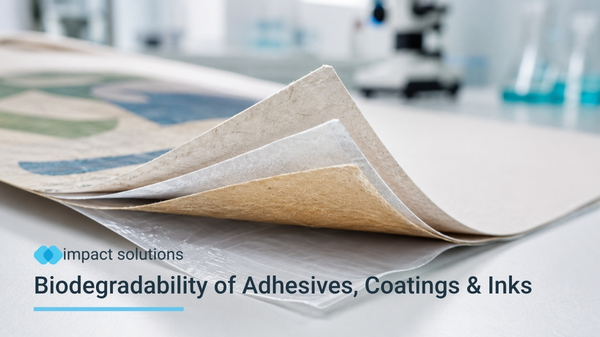
Adhesives, coatings, inks, sealants and other components can all become part of the final construction. That matters because the environmental performance of the finished product may differ from that of the base material on its own.
For manufacturers developing products around biodegradability or compostability, testing the complete construction can therefore provide a more realistic picture.
Why the finished product matters
Consider a fibre-based package designed to biodegrade or compost.
The main substrate may perform well under the intended conditions, but the finished pack could also include a moisture-resistant coating, printed graphics and an adhesive joining different sections together.
These additional components may account for only a small proportion of the total product, but their presence can still affect how the product behaves.
Impact-Bio® can assess a range of materials including packaging films, coatings, labels, adhesives and laminates, as well as finished formulations and product components.
This allows testing to look beyond the dominant substrate and consider how the complete construction may perform.
Coatings can influence biodegradation behaviour
Coatings are commonly used to improve barrier performance, moisture resistance, grease resistance or durability.
Those properties are valuable during a product’s useful life, but they can also affect what happens after disposal.
A coating may influence how easily moisture and microorganisms reach the underlying material. The coating itself may also behave differently from the substrate beneath it.
As a result, a paper, fibre or polymer material that performs well when tested on its own may not behave in exactly the same way once the final coating system has been applied.
Testing the coated construction can help build a clearer picture of how the finished product behaves in its intended end-of-life environment.
Adhesives should not be treated as insignificant
Adhesives often represent a small percentage of overall product weight, but they can still play an important role in labels, laminates, packaging structures and other multi-material products.
They may affect how layers remain bonded, how quickly a structure breaks apart and how the complete product behaves during degradation or disintegration.
For home-compostable products, final-product testing may need to consider inks, adhesives and additives rather than relying only on data for the main substrate.
That distinction is important.
Evidence relating to a biodegradable film on its own does not necessarily demonstrate how the finished laminate, label or bonded structure will behave.
Printing inks become part of the construction too
Printing is often one of the final stages of product manufacture, but it should not necessarily be one of the final considerations in environmental testing.
Ink formulations can contain pigments, binders, solvents and other components. Once printed onto a product, those materials become part of the finished construction.
Comparing materials at different stages of development can help manufacturers understand whether the addition of inks, adhesives or coatings has changed the overall biodegradation behaviour.
Impact-Bio® can support the assessment of finished formulations and products containing these additional components under appropriate biodegradation conditions.
Testing should match the intended end-of-life environment
There is no single biodegradability test that is suitable for every product.
A product intended for industrial composting faces different conditions from one expected to break down in soil, freshwater, wastewater, marine environments or anaerobic digestion.
Impact-Bio® offers testing across a range of recognised ISO, ASTM, OECD and BSI methodologies.
The appropriate route depends on the product, its intended disposal environment and the type of environmental claim being investigated.
Selecting the right test is therefore just as important as selecting the right material.
A scientifically valid result may still have limited value if the conditions tested do not reflect the product’s intended end-of-life route.
Rapid screening can support development decisions
Biodegradability testing does not have to begin only once the final formulation has been chosen.
Rapid biodegradability screening can provide earlier insight during material and formulation development.
This can be particularly useful when several potential coatings, adhesives or formulation options are being considered.
Instead of committing immediately to a longer standard testing programme, early-stage screening can help development teams compare options and identify those that appear most promising.
A practical development pathway may therefore look like:
screening → comparison → optimisation → standard testing
This makes biodegradability testing part of the product-development process rather than something considered only when a product is ready to launch.
Testing the product you actually intend to sell
A biodegradable substrate can be an important starting point, but it does not always tell the complete environmental story.
Adhesives, coatings and inks may all influence how the finished product behaves under its intended end-of-life conditions.
Testing a representative construction can therefore provide more meaningful evidence than relying only on information about individual raw materials.
Impact-Bio® can support businesses with rapid biodegradability screening and testing across recognised methodologies and relevant environmental conditions.
By considering coatings, adhesives, inks and other components earlier in development, manufacturers can make better-informed material decisions and build a stronger evidence base around the environmental performance of the finished product.
Contact our technical team to discuss the right testing programme for your ptoduct.
FAQ
Q. Can coatings affect the biodegradability of a product?
Yes. A coating can influence how moisture and microorganisms interact with the underlying material, while the coating itself may have different degradation characteristics. Testing the finished coated construction can therefore provide a more representative picture than assessing the substrate alone.
Q. Should inks and adhesives be included in biodegradability testing?
Where they form part of the final product, they should be considered when developing a representative testing strategy. This is particularly relevant for printed, laminated or bonded products where the final construction differs significantly from the original substrate.
Q. What biodegradability testing does Impact-Bio® offer?
Impact-Bio® offers rapid biodegradability screening and testing across recognised methodologies for a range of relevant environments, including composting, soil, aqueous, marine and anaerobic conditions. The most appropriate testing route depends on the product, intended end-of-life environment and the claim being investigated.