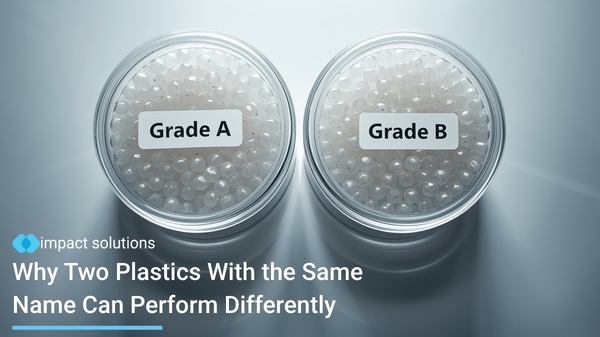
Polypropylene is polypropylene. Polyethylene is polyethylene. PVC is PVC.
It sounds straightforward, but anyone involved in plastics manufacturing, product development or quality control will know that two materials carrying the same polymer name can behave very differently.
One polypropylene component may remain tough after years of use, while another becomes brittle. Two polyethylene grades may process differently on the same production line. A replacement material may match the original specification on paper but still produce unexpected failures in the finished product.
The reason is simple: the polymer name only tells part of the story.
A plastic is more than its base polymer
Commercial plastics are rarely made from a base polymer alone. A finished material may contain a combination of fillers, pigments, stabilisers, plasticisers, impact modifiers, flame retardants and processing aids.
Each component is introduced for a particular reason. A UV stabiliser may improve outdoor durability, while an impact modifier can help a rigid material resist cracking. Fillers may increase stiffness, reduce costs or alter dimensional stability.
Even relatively small formulation differences can change how a material processes and performs. Two products may both be described as polypropylene, but one could contain mineral filler while the other includes rubber modifiers to improve impact resistance.
Without plastic composition analysis, those differences may not be obvious from the material name or its appearance.
Different grades are designed for different jobs
Within each polymer family, manufacturers produce multiple grades for different applications.
A polyethylene grade developed for flexible film will not have the same characteristics as one intended for pressure pipes. Likewise, polypropylene used in food packaging may differ significantly from a grade designed for an automotive component.
Grades can vary in:
- Melt flow behaviour
- Stiffness and flexibility
- Impact resistance
- Chemical resistance
- Temperature performance
- Clarity and appearance
- Environmental stress-crack resistance
Substituting one grade for another can therefore affect processing conditions, product dimensions and long-term durability, even when both materials share the same general polymer classification.
Molecular weight affects processing and performance
Polymers are made from long molecular chains, and the length and distribution of those chains can have a significant influence on material behaviour.
Higher molecular weight may improve toughness, chemical resistance and mechanical strength. However, it can also increase melt viscosity, making the material more difficult to process.
Lower molecular weight materials may flow more easily during moulding or extrusion but may not provide the same long-term mechanical performance.
The distribution of different chain lengths is also important. Two polymers with a similar average molecular weight can still behave differently if their molecular weight distributions are not the same.
Gel permeation chromatography, or GPC, can be used to examine molecular weight distribution and help identify whether differences in polymer structure may be contributing to processing or performance problems. Impact Solutions offers GPC alongside analytical methods including GC-MS, HPLC and ICP-OES.
Additive packages can change over time
Additives help plastics achieve the properties required for a particular application, but their effectiveness can be affected by processing and ageing.
Excessive heat during production may consume stabilisers or begin degrading the polymer. UV exposure, oxygen, chemicals and elevated temperatures can continue to alter the material throughout its service life.
An incorrectly processed plastic may therefore have the correct initial formulation but a reduced level of protection against future degradation.
Additives can also migrate, react or become depleted. This may lead to changes in colour, flexibility, strength, surface appearance or resistance to cracking.
Fourier transform infrared spectroscopy, commonly known as FTIR, can help identify chemical changes associated with polymer oxidation and ageing. Thermogravimetric analysis can also provide information about thermal stability, fillers, volatile content and material composition.
Manufacturing history matters
The same plastic formulation can produce different results when processed under different conditions.
Temperature, cooling rate, pressure, residence time and shear can all influence the final structure of a plastic product. Poor dispersion of fillers or pigments may create weak areas, while excessive processing temperatures may cause premature degradation.
Recycled polymers introduce another variable. Every processing cycle can alter the material, particularly when waste streams contain mixed grades, contaminants or unknown additive packages.
This means a raw-material specification alone may not explain why a finished component has failed. The investigation may also need to consider how the material was stored, processed and used.
How plastic material testing identifies the difference
When two apparently similar plastics perform differently, relying on appearance or supplier documentation may not provide a clear answer.
A structured polymer testing programme can compare the materials from several perspectives:
- FTIR can identify the base polymer and detect chemical changes.
- GPC can assess molecular weight and molecular weight distribution.
- TGA can examine thermal stability, filler content and decomposition behaviour.
- DSC can compare melting behaviour, crystallinity and thermal transitions.
- GC-MS or HPLC can investigate additives, impurities and degradation products.
- ICP-OES can identify and quantify metals or inorganic elements.
- Mechanical testing can confirm how compositional differences affect physical performance.
Impact Solutions has previously demonstrated how FTIR and thermal analysis can distinguish between plastic formulations, including identifying polypropylene blended with polyethylene and detecting flame-retardant additives in polypropylene products.
The most useful approach will depend on the product, the suspected difference and the problem being investigated.
Look beyond the material name
Two plastics with the same name are not necessarily interchangeable.
Differences in grade, molecular weight, additives, fillers, processing conditions and ageing history can all influence how a material behaves. These variations may affect everything from production efficiency to product safety and service life.
Plastic material testing provides the evidence needed to compare materials properly, investigate unexpected failures and make more informed decisions about suppliers, formulations and replacement grades.
Impact Solutions combines analytical testing, material characterisation and physical testing to help manufacturers understand what their plastic products contain, why they perform differently and whether they are suitable for their intended application.
Follow us on LinkedIn, Facebook and Instagram for more industry insights and service updates.
FAQ
Can two plastics with the same polymer name have different properties?
Yes. Two materials may share the same base polymer but contain different grades, additives, fillers or molecular weight distributions. They may also have been processed differently, resulting in noticeable differences in strength, flexibility, durability or processing behaviour.
How can you identify the composition of an unknown plastic?
Techniques such as FTIR can help identify the base polymer, while TGA, DSC, GC-MS, HPLC and elemental analysis can provide further information about fillers, additives, impurities and thermal properties. Several techniques may be needed for a complete plastic composition analysis.
What tests can compare two batches of plastic?
The appropriate tests depend on the suspected problem. FTIR can compare chemical fingerprints, GPC can examine molecular weight distribution, and thermal analysis can reveal differences in composition or material transitions. Mechanical testing can then determine whether those differences affect practical performance.