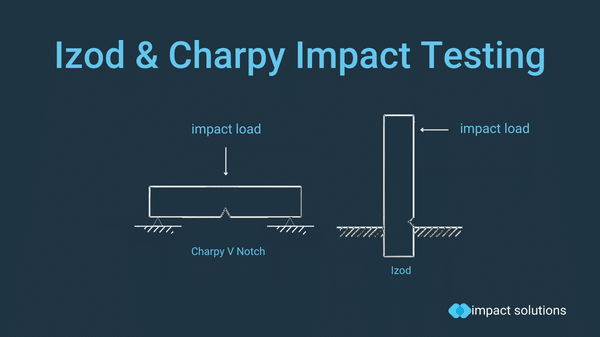
Izod and Charpy are both pendulum impact tests used to assess how a material behaves when subjected to a sudden load. The main difference is the way the test specimen is positioned and supported.
In an Izod impact test, the specimen is mounted vertically and clamped at one end. The pendulum strikes the specimen above the point where it is fixed.
In a Charpy impact test, the specimen is positioned horizontally and supported at both ends. The pendulum strikes the specimen between the supports.
These different test arrangements create different loading conditions, so Izod and Charpy results should not be treated as directly interchangeable.
For plastics and polymers, the appropriate method is usually determined by the relevant material specification, product standard or customer requirement.
Izod vs Charpy at a glance
| Izod impact test | Charpy impact test | |
|---|---|---|
| Specimen position | Vertical | Horizontal |
| Support | Clamped at one end | Supported at both ends |
| Impact configuration | Cantilever arrangement | Three-point bending arrangement |
| Common plastics ISO standard | ISO 180 | ISO 179-1 |
| Common ASTM standard | ASTM D256 | ASTM D6110 |
| Main purpose | Comparative impact behaviour | Comparative impact behaviour |
| Results interchangeable? | No | No |
What is an Izod impact test?
The Izod test uses a pendulum to strike a specimen that is held vertically and clamped at one end. The energy absorbed during fracture is used to determine the material’s impact behaviour under the specified test conditions.
Izod impact testing is commonly used to compare plastic materials, investigate changes in formulation or processing, and assess performance against a specified requirement.
Testing may be carried out using notched specimens depending on the applicable standard and test requirement.
What is a Charpy impact test?
In a Charpy test, the specimen is positioned horizontally and supported at both ends. A pendulum strikes the specimen between the supports and the energy absorbed during fracture is measured.
Like Izod testing, Charpy testing provides comparative information about how a material behaves under defined impact conditions.
It can be used when comparing materials or grades, assessing the effect of changes to a material, or testing against a specified requirement.
Should I use an Izod or Charpy impact test?
Neither test is inherently better than the other. The appropriate method depends on what your material, product or customer specification requires.
If a specification identifies ISO 180 or ASTM D256, this will normally indicate an Izod test. Requirements based on ISO 179-1 or ASTM D6110 will normally indicate Charpy testing.
Existing test data should also be considered. Because the specimen arrangement and loading conditions differ, an Izod result should not simply be substituted for a Charpy result or vice versa.
If you are unsure which test applies, send Impact Solutions your material information and relevant specification before preparing test specimens.
Discuss Your Impact Testing Requirements
Notched vs unnotched impact testing
Some impact tests use a notched specimen, while others may use an unnotched specimen depending on the standard and purpose of the test.
A notch creates a defined stress concentration within the specimen. This helps assess how the material behaves when a crack or similar stress concentration is present.
The quality and geometry of the notch are important because they can affect the measured result.
Whether a notched or unnotched specimen is required should therefore be determined from the relevant test method rather than selected independently.
What can Izod and Charpy testing tell you?
Izod and Charpy tests can provide useful comparative information about the impact behaviour of plastics and polymer materials.
Depending on the project, impact testing can be used to:
- compare different materials or grades
- assess formulation changes
- investigate the effect of processing conditions
- compare material performance at different conditions
- support quality control
- investigate unexpected brittle behaviour
- assess performance against a material or product specification
The results relate to the specified specimen and test conditions. They should not be treated as a direct prediction of how a complete product will behave under every real-world impact event.
What materials can be tested?
Pendulum impact testing is commonly used for rigid plastic and polymer materials.
Depending on the method and specimen requirements, this can include thermoplastics, thermosetting materials, filled or reinforced polymers and suitable composite materials.
The appropriate method and specimen configuration will depend on the material being assessed and the applicable test standard.
If you are unsure whether your material is suitable for Izod or Charpy testing, our laboratory team can review your requirements before samples are prepared.
Izod and Charpy impact testing at Impact Solutions
Impact Solutions provides Izod and Charpy impact testing for plastics and polymers from our UK materials testing laboratory.
Testing can be carried out using recognised ISO and ASTM methods, including ISO 180 and ASTM D256 for Izod testing, and ISO 179-1 and ASTM D6110 for Charpy testing.
Impact Solutions also provides a wider range of mechanical, analytical and materials testing capabilities, allowing impact results to be investigated further where required.
If you already know the test method you require, send us your specification, material details and available sample information.
If you are unsure whether Izod or Charpy testing is appropriate, our team can discuss the available testing options with you.
FAQ
What is the main difference between Izod and Charpy testing?
The main difference is how the specimen is positioned and supported. In Izod testing, the specimen is vertical and clamped at one end. In Charpy testing, the specimen is horizontal and supported at both ends.
Can Izod and Charpy results be compared directly?
No. Izod and Charpy use different specimen arrangements and loading conditions, so results from the two methods should not be treated as directly interchangeable.
If you need to compare materials, they should ideally be tested using the same method and equivalent test conditions.
Which is better, Izod or Charpy?
Neither method is universally better. The appropriate test usually depends on the relevant material standard, product specification, customer requirement or existing test data.
If a particular standard has already been specified, this should normally determine whether Izod or Charpy testing is required.