One of the most common misunderstandings we see in biodegradability testing is the assumption that a formulation made from biodegradable ingredients will automatically be biodegradable as a finished product.
It sounds logical. If each raw material has favourable biodegradability data, why would the mixture be any different?
The problem is that ingredient-level data and finished-product performance are not the same thing. Once those ingredients are combined, the formulation becomes the material that will actually be manufactured, sold and used. If a biodegradability claim is being made about that finished product, the supporting evidence needs to reflect the product as a whole.
Ingredient data is a starting point, not the final answer
Choosing ingredients with good biodegradability profiles is valuable during product development. It can help formulators make more informed material choices and give an early indication of how a formulation might perform.
But those data should not simply be added together and treated as proof that the final formulation is readily biodegradable.
Different ingredients may biodegrade at different rates. Some may be readily available to microorganisms, while others may be less soluble or degrade more slowly. Their behaviour can also change once they are part of a mixture.
This is why a formulation can look promising on paper but still fail to meet a ready-biodegradability threshold when tested as a whole.
What does OECD 301F tell you?
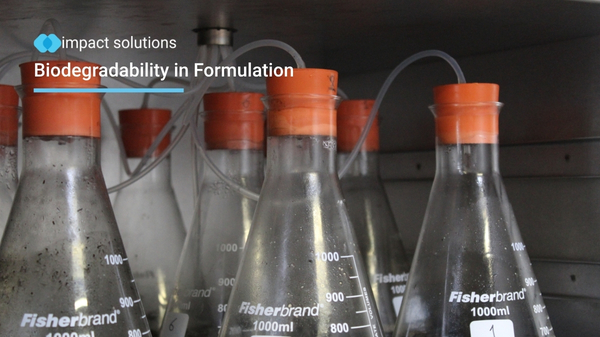
OECD 301F is a manometric respirometry test used to assess ready biodegradability under aerobic conditions. It measures the oxygen consumed by microorganisms as they break down the test material over a 28-day test period.
The result is compared with the material’s theoretical oxygen demand, or ThOD. For OECD 301F, the pass level for ready biodegradability is 60% of ThOD, together with the relevant test criteria.
When a formulation is tested, the result applies to the test material in the vessel as a whole. OECD 301F does not provide a separate biodegradation result for every individual ingredient.
In other words, favourable data for the individual components cannot simply be used as a substitute for evidence about how the complete formulation performs.
Why can a formulation fail when the ingredients look good?
There is no single reason.
A finished formulation may contain components that biodegrade at different rates, or ingredients that behave differently once combined. Physical characteristics such as solubility and dispersion can also affect how available the test material is to microorganisms.
The result may therefore be different from what would be predicted by looking at each ingredient separately.
This is an important distinction. If a finished formulation fails to meet the criteria for ready biodegradability, it does not necessarily mean that the ingredient data were incorrect. It means that, under the conditions of the test, the formulation itself did not meet the required criteria.
That is why formulation-level evidence matters.
Claims need to match the evidence
This distinction is also important when making environmental claims.
The UK Green Claims Code says environmental claims should be supported by credible evidence and should not give consumers a misleading impression about the whole product when the evidence only relates to part of it. It specifically notes that claims such as “biodegradable” can be problematic where they only apply to part of a product or only under certain conditions.
So, if a biodegradability claim is being made about a finished formulation, relying only on data for selected ingredients can leave a gap between the claim and the evidence supporting it.
Where OECD 301F is scientifically appropriate, testing the final formulation can provide direct evidence of how the mixture behaves as a whole.
There is an important qualification, though. OECD notes that ready-biodegradability tests were developed primarily for individual chemicals. They can be relevant for some mixtures, particularly mixtures of structurally similar substances, but they are not generally applicable to complex mixtures containing different types of chemicals. The suitability of the test therefore needs to be considered on a case-by-case basis.
What does this mean?
Biodegradable ingredients are a good foundation, but they do not automatically make a finished formulation readily biodegradable.
If the claim is about the finished product, the evidence needs to support the finished product. Ingredient-level data can help guide formulation development, but the behaviour of the final mixture still needs to be understood.
For R&D teams, the question should not simply be, “Are the ingredients biodegradable?”
It should also be: “What evidence do we have that the formulation we are actually selling performs as expected?”
Get in touch with our technical team for more information on biodegradabilty testing and OECD 301F.
FAQ
If every ingredient is biodegradable, can I call the formulation biodegradable?
Not automatically. Ingredient data can support product development, but they do not by themselves demonstrate the biodegradability of the finished formulation. The wording and scope of any claim should match the evidence available.
Why might a finished formulation fail OECD 301F?
Ingredients can degrade at different rates and may behave differently when combined. Solubility, dispersion and the overall composition of the mixture can all affect the result. A formulation can therefore fail the ready-biodegradability criteria even when its ingredients have favourable individual data.
Should the final formulation be tested?
If the claim relates to the finished formulation, evidence relevant to that finished product is important. Where OECD 301F is suitable for the material, whole-formulation testing can provide this evidence. For complex mixtures, the suitability of OECD 301F should first be considered on a case-by-case basis.