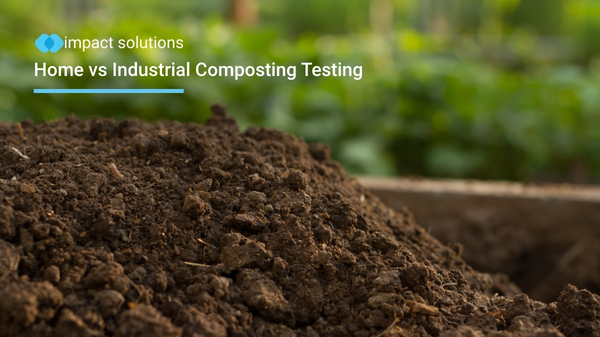
As demand for sustainable packaging grows, understanding the difference between home composting and industrial composting is essential. While both aim to break materials down into environmentally safe components, the way they are tested and the conditions required vary significantly.
A home compostable product should be designed to break down in a domestic compost bin or heap at ambient outdoor temperatures without special equipment. It should break down into natural materials within a reasonable time under those conditions.
An industrial compostable product needs the controlled conditions of a commercial composting facility, such as higher temperatures, managed moisture and specific microbes, to break down properly.
This article compares testing standards for home and industrial composting, focusing on verified differences in methodology and certification.
What Is Compostability Testing?
Compostability testing determines whether a material will biodegrade in compost within a defined timeframe, under specific conditions, without leaving harmful residues. It also evaluates ecotoxicity to ensure the resulting compost supports plant growth.
Because home and industrial composting environments differ significantly, each uses distinct testing approaches.
Key Criteria in Composting Standards
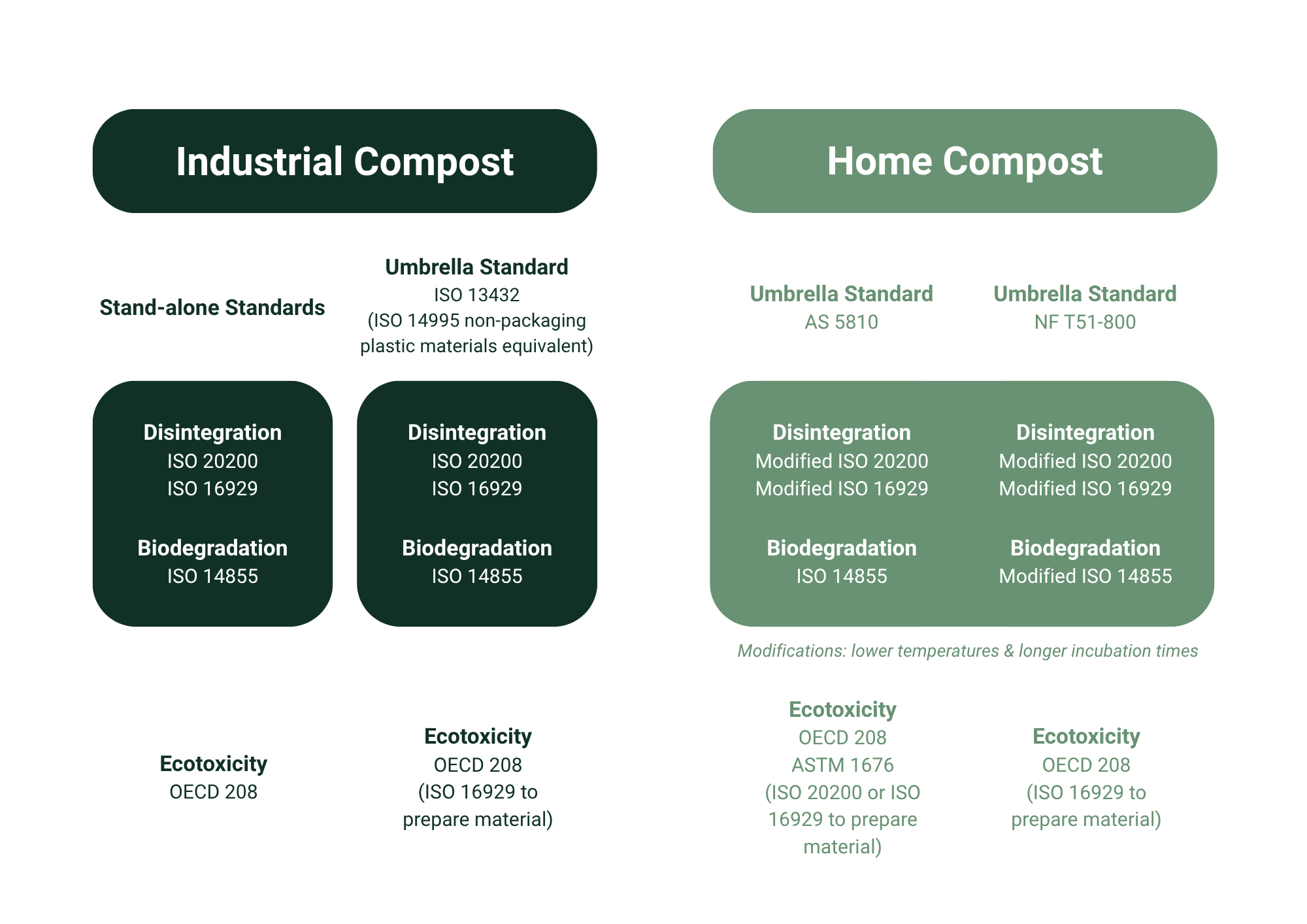
Composting standards are umbrella standards which encompass several standalone standards. Combining these standalone standards together requires a greater body of evidence to support claims made. There are separate umbrella standard for home and industrial composability, however they have similar key features.
Typical umbrella standards: BS EN 13432, ISO 14995, AS 5810, NF T51-800
Characterisation
The chemical composition of the product is investigated to ensure there are no toxic components. Typical testing includes the identification of constituents; heavy metals and the determination of the total organic carbon found within the material.
Disintegration
The materials ability to break down into small particles is tested under composting conditions. The first step in biodegradation is to ensure that the product breakdown in small enough particles to be consumed by microbes, like cutting up your food before you eat it if you will.
Typical standalone standards: ISO 20200, ISO 16929
Biodegradation
The material should be ultimate biodegradability shall be determined under composting conditions. This step ensures that small particles produced by disintegration can be fully consumed by microbes.
Typical standalone standards: ISO 14855
Ecotoxicity
The remaining residue of the product from the composting process should be environmentally benign. The quality of the compost produced is tested through plant growth trials.
Typical standalone standards: OECD 208
Key Differences between Testing Standards
Testing Standards
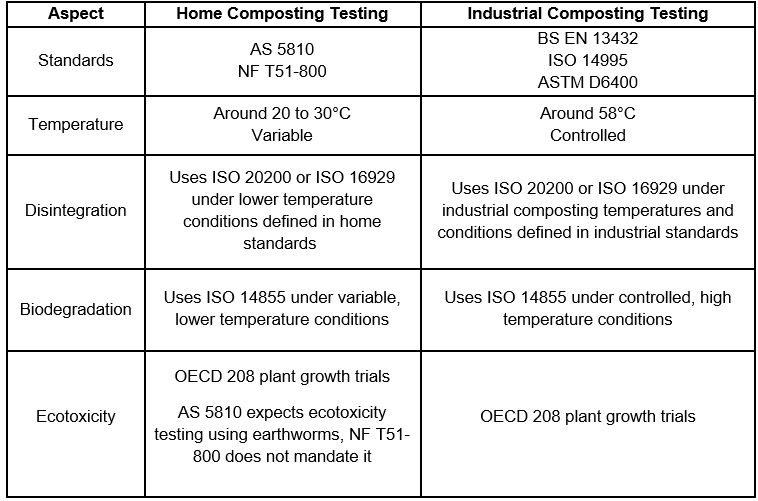
A major difference lies in the standards used. To make a claim of suitable for home/industrial compost the product must pass all the criteria set out in the relevant umbrella standard.
Industrial composting is governed by well-established international standards, including:
- BS EN 13432
- ISO 14995
- ASTM D6400
These standards are aligned with conditions found in commercial composting facilities and are widely recognised across markets.
Home composting uses fewer and more region-specific standards, primarily:
- AS 5810
- NF T51-800
These standards are aligned with conditions found in the domestic composting process.
Temperature Conditions
Temperature is one of the most important variables in composting.
- Industrial composting tests are based on sustained elevated temperatures, typically around 58°C, which reflect conditions in controlled facilities.
- Home composting tests are conducted at lower temperatures, often around 20 to 30°C, where conditions fluctuate and microbial activity is less consistent.
This difference directly affects how quickly and completely materials break down.
Ecotoxicity
Both systems include testing to ensure the final compost is safe.
- Ecotoxicity tests, such as OECD 208 plant growth trials, are used in both home and industrial composting to confirm that compost supports plant development.
- AS 5810 explicitly requires earthworm toxicity testing, commonly using methods such as ASTM E1676, to assess the impact on soil organisms.
- BS EN 13432 & NF T51-800, while also requiring ecotoxicity assessment, does not mandate a specific earthworm test method.
These requirements are broadly similar in purpose, although specific methods and thresholds can vary between standards.
Summary of Key Differences
Final thoughts
Home and industrial composting testing are built around fundamentally different environmental assumptions. Home composting testing reflects lower, variable temperatures and less controlled conditions whereas, Industrial composting testing, by contrast, is designed around controlled systems operating at around 58°C.
There are separate standards for home and industrial composting, but they are related. Both home and industrial composting standards have 4 key requirements:
- Chemical analysis – Determination of toxic components e.g. heavy metals
- Disintegration – Does the material break down into small chunks?
- Biodegradation – Can the small chunks be consumed by microbes?
- Ecotoxicity – Are the remaining residues toxic to plants?
In the Industrial composting standards (e.g BS EN 13432) criteria 2 and 3 are conducted at higher temperatures to simulate the industrial composting process. In the Home composting standards (e.g AS 5810 or NFT51-800) criteria 2 and 3 are conducted at lower temperatures to simulate the domestic composting process. Criteria 1 and 4 are the same in Industrial and Home composting standards. To make a claim of suitable for home/industrial composting the product the product must pass all four criteria of the relevant standard.
Overall, while both home and industrial composting tests evaluate the same core criteria, including disintegration, biodegradation and ecotoxicity, they do so using different environmental assumptions. These frameworks are not interchangeable, and results from one cannot be directly applied to the other.
Enhance Your Claims Today
If your product has already undergone testing for compostability under industrial conditions and has been certified under TUV or other similar bodies, you may be able to easily, and cost effectively, upgrade these claims to cover home compostability as well.
Several areas of the industrial composting testing framework are also present within the home composting framework. Most of the testing legwork required could already be in place.
Get in touch with our team to find out what additional testing is required to upgrade your products claims today.