


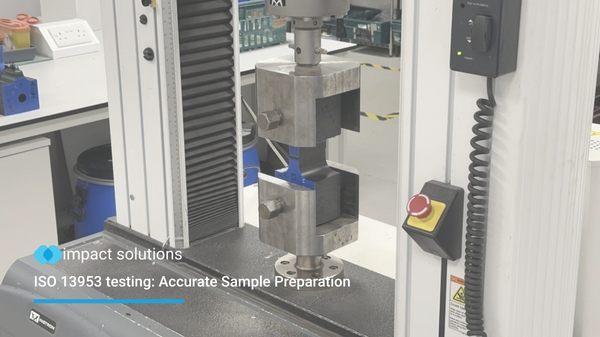
In sectors such as utilities, construction, water infrastructure and energy, polyethylene and thermoplastic pipeline systems are widely used because of their durability. However, the performance of these systems depends heavily on the quality of the fusion joints that connect individual pipe sections.
Pull testing in accordance with ISO 13953 plays a vital role in verifying joint strength and integrity. However, proper sample preparation plays a vital role in achieving accurate results, as well as maintaining compliance.
Impact Solutions supports the process of accurate sample preparation by offering in-house machining processes, as well as a team experienced in the handling of pipe samples.
Understanding Pull Testing to ISO 13953
ISO 13953 specifies a method for determining the tensile strength and failure behaviour of butt fusion joints in thermoplastic pipes. The test involves applying a controlled tensile force to a prepared specimen until failure occurs. The objective is to assess whether the joint can withstand the mechanical stresses it may encounter during installation or service and assess the failure mechanism; both key indicators of the quality of the weld.
For the test to provide meaningful data, the specimen must be prepared with the correct geometry and alignment so that the applied load is distributed consistently across the fused joint.
Why Accurate Sample Preparation Is Essential
One of the main reasons correct pipe sample preparation is important is to ensure testing accuracy. Mechanical test specimens must be machined to exact dimensions with smooth surface finishes and consistent geometry. Even small deviations can introduce stress concentrations during testing.
Accurate preparation helps laboratories obtain repeatable and meaningful results that reflect true material performance.
Maintaining Representative Fusion Joint Characteristics
Butt fusion joints are influenced by factors such as heating temperature, fusion pressure, cooling time and operator technique. These variables affect the microstructure and mechanical performance of the welded interface. During sample preparation, it is important that these characteristics remain unchanged.
Professional preparation processes use controlled cutting speeds and appropriate tooling to prevent overheating or deformation of the thermoplastic material. This ensures that the pull test reflects the true quality of the original fusion weld.
Meeting ISO 13953 Dimensional and Alignment Requirements
ISO 13953 outlines specific requirements for specimen dimensions, gauge length and alignment within the tensile testing machine. Even slight inconsistencies can lead to uneven stress distribution during the pull test, increasing the risk of misleading results.
By using experienced testing facilities, organisations can more effectively demonstrate compliance. This is particularly important in sectors where traceability and certification are critical to project approval.
Enhancing Safety and Risk Management
Pipelines often operate under high levels of mechanical stress. ISO 13953 testing helps to verify that materials can withstand these demands. However, inaccurate sample preparation can lead to misleading results and the potential approval of unsuitable materials.
Correctly prepared specimens provide engineers with reliable data for safety assessments and integrity management planning. This reduces the likelihood of failures which could disrupt operations, as well as pose risks to both the public and the environment.
Reducing Retesting and Project Delays
Incorrectly prepared pull test specimens can lead to inconclusive or failed results that require retesting. This can increase laboratory costs and potentially delay project schedules.
Using reliable testing facilities, such as Impact Solutions, helps reduce the risk of such setbacks. Consistent sample quality improves testing efficiency and supports smoother project progression, particularly on large infrastructure developments where timeframes are tightly managed.
Ensuring Confidence in Fusion Joint Performance
Ultimately, the purpose of pull testing to ISO 13953 is to confirm that butt fusion joints can perform reliably under tensile stress. Correctly prepared samples provide the foundation for this assurance by allowing the test method to function as intended.
By prioritising precision preparation techniques and adherence to standardised requirements, organisations can strengthen quality control processes, demonstrate compliance and help ensure the long-term durability of thermoplastic pipeline systems. Attention to detail at the preparation stage is therefore a key factor in achieving dependable testing outcomes and maintaining confidence in fusion joint integrity.
To find out more about our in-house sample preparation services, or ISO 13953 testing, get in touch with our team or contact Impact Solutions online today.
FAQ
What is ISO 13953 pull testing?
ISO 13953 is a standard test method used to determine the tensile strength and failure behaviour of butt fusion joints in thermoplastic pipes.
Why is sample preparation important for ISO 13953 testing?
Accurate sample preparation ensures that test results reflect the true strength and integrity of the fusion joint, avoiding misleading failures caused by defects introduced during cutting or machining.
What does a successful pull test result indicate?
A successful result indicates that the butt fusion joint has sufficient strength and has failed in a way that meets the acceptance criteria set out in the standard, confirming the quality of the weld.