Surface Roughness Testing of Plastics
Impact Solutions provides surface roughness testing for plastic materials to assess surface texture, finish quality, and functional performance.
This testing is widely used in quality control, product development, and failure analysis across industries such as packaging, medical devices, and engineering plastics.
What is Surface Roughness Testing?
Surface roughness testing is the process of measuring and quantifying the texture of a material’s surface to determine how smooth or rough it is.
It provides objective data to ensure materials meet design, manufacturing, and performance requirements.
Why is Surface Roughness Important?
Surface finish plays a critical role in how plastic components perform in real-world applications. Significant differences in surface roughness can obviously lead to visual differences between two identically manufactured parts. However, even if the differences are not visible to the naked eye, acute differences can affect the amount of wear, ability to form a seal when a part makes contact with another surface, paint or coating ability of the part, etc. The internal surface roughness of pipes can affect the flow of fluid, resulting in pressure and energy losses. Surface texture directly influences functional performance in engineering and polymer applications.
Key Benefits of Surface Roughness Testing
- Ensure consistent product quality
- Improve sealing and fit performance
- Control friction and wear characteristics
- Enhance optical clarity for transparent plastics
- Support coating and adhesion performance
- Detect manufacturing defects or process variation
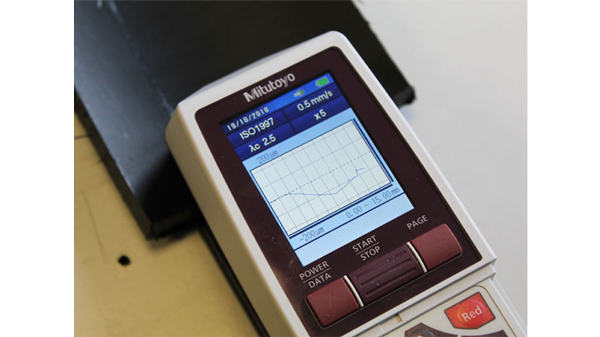
Impact Solutions uses the state-of-the-art Mitutoyo Surftest SJ-210 Portable Surface Roughness Tester. This tester is portable, making it possible to perform measurements on site and on parts with difficult-to-access areas. The tester uses a stylus-type probe of radius 5µm. It comes with a calibrator to calibrate and perform equipment checks.
The Surftest SJ-210 complies with the following standards: JIS (JIS-B0601-2001, JIS-B0601-1994, JIS B0601-1982), VDA, ISO-1997, and ANSI.
It can perform the following measurements:
Ra – arithmetical mean roughness value.
Rmr(c) – material component of the profile.
RSm – mean peak width.
Rt – total height of the roughness profile
Rzi – greatest height of the roughness profile
Rz1max – maximum roughness depth
Rz – mean roughness depth
Applications of Surface Roughness Testing
Surface roughness testing is used across many industries, including:
- Injection moulded plastic components
- Packaging films and containers
- Medical and diagnostic devices
- Sealing surfaces and gaskets
- Optical and transparent plastics
- Automotive and engineering components
Be sure to contact a member of our team to learn more about the testing process and what you can expect from the impact team!
To learn more about us, be sure you are following us on LinkedIn.