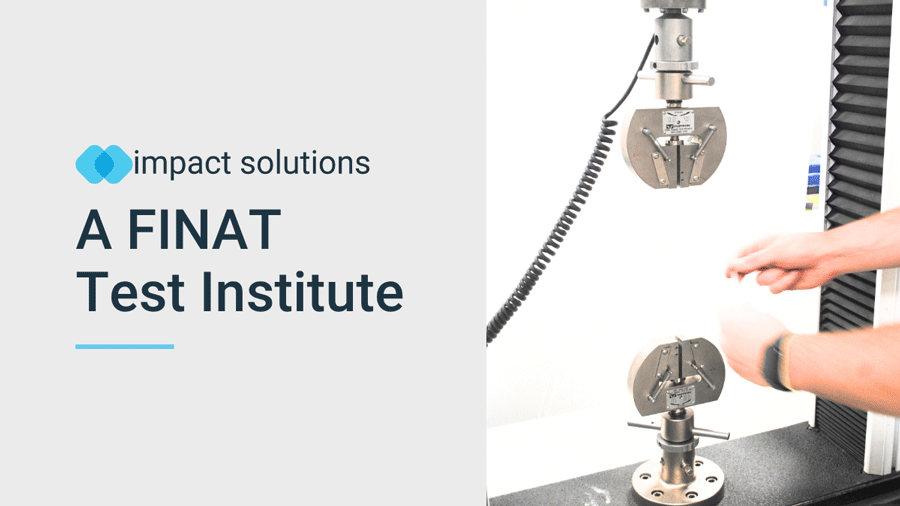
Peel Test – Rubber Adhesion
The bond between rubber and a rigid substrate is critical to the performance and durability of many engineered components. Poor adhesion can result in separation, delamination and premature component failure, particularly where rubber-to-metal assemblies are subjected to repeated loading, vibration or demanding service conditions.
Variations in rubber compounds, substrate preparation, bonding agents, vulcanisation conditions and manufacturing processes can all affect adhesion performance. Manufacturers therefore need reliable testing to evaluate bond quality, compare material and process combinations and identify potential adhesion problems before components enter service.
ASTM D429 provides recognised methods for determining the static adhesion strength of rubber to rigid substrates, most commonly metals. The standard supports the development and control of rubber compounds and manufacturing processes and can also be used to obtain comparative adhesion values from suitable production components.
What ASTM D429 Rubber Adhesion Testing Involves
ASTM D429 covers a series of test methods designed to evaluate the adhesion of rubber to rigid materials. Although other rigid substrates may be assessed, the standard is primarily concerned with rubber bonded to metal.
Depending on the product, bond configuration and testing requirements, ASTM D429 includes several different methods, including:
- Method A – rubber assembled between two parallel metal plates
- Method B – 90° stripping of rubber assembled to one metal plate
- Method C – adhesion of rubber to metal using a conical specimen
- Method D – post-vulcanisation bonding of rubber to metal
- Method E – 90° stripping of rubber tank lining from a metal plate
- Method F – rubber assembled between convex-shaped metal plates
- Methods G and H – bond durability configurations for rubber-to-metal bonded components
The current active standard is ASTM D429-14(2023).
For applications requiring a peel or stripping configuration, the appropriate ASTM D429 method allows the rubber to be progressively separated from its rigid substrate under controlled loading.
Testing can be applied to materials and components including:
- Rubber-to-metal bonded components
- Elastomeric coatings and linings
- Anti-vibration components
- Rubber mounts
- Bonded seals and engineered components
- Vulcanised rubber-to-metal assemblies
- Production components where suitable specimens can be prepared
Depending on the selected method, testing can provide information relating to:
- Rubber-to-substrate adhesion strength
- Peel or stripping force
- Maximum separation force
- Bond consistency
- Adhesive failure
- Cohesive failure within the rubber
- Comparative performance of bonding systems
- Effects of material or manufacturing changes
The results provide valuable information about the integrity of the rubber-to-substrate interface and can support material development, manufacturing control and failure investigation.
Methodology
At Impact Solutions, rubber adhesion testing is carried out using calibrated mechanical testing equipment and appropriate fixtures in accordance with the applicable ASTM D429 method.
A typical testing programme includes:
- Identification of the appropriate ASTM D429 test method for the component or material.
- Preparation of representative rubber-to-substrate test specimens.
- Conditioning of specimens where required by the testing programme.
- Measurement and inspection of specimens prior to testing.
- Installation of the specimen within the appropriate test fixture.
- Application of controlled mechanical loading in accordance with the selected ASTM D429 method.
- Measurement and recording of the force required to separate or disrupt the rubber-to-substrate bond.
- Assessment of the exposed surfaces and resulting failure mode.
- Comparison of results between materials, bonding systems or production conditions where required.
- Comprehensive reporting of test conditions, adhesion results and observations.
Testing is performed under controlled laboratory conditions to provide accurate, repeatable and reliable rubber adhesion performance data.
Relevant Industry Applications
ASTM D429 rubber adhesion testing is relevant to:
- Automotive components
- Anti-vibration mounts
- Industrial rubber products
- Rubber-to-metal components
- Engineering seals
- Suspension and isolation components
- Tank and vessel linings
- Machinery components
- Rail and transport applications
- Oil and gas components
- Rubber compound development
- Bonding process development
- Manufacturing quality assurance
- Product and failure investigations
ASTM states that several of the methods are applicable to products where rubber is used for vibration control, making the standard particularly relevant to bonded engineering components and anti-vibration applications.
Benefits of ASTM D429 Rubber Adhesion Testing
- Quantifies rubber-to-substrate adhesion performance
- Evaluates the integrity of rubber-to-metal bonds
- Identifies weak bonding interfaces
- Supports development of rubber compounds and bonding processes
- Enables comparison between alternative adhesives and surface treatments
- Helps assess the effect of manufacturing process changes
- Supports quality assurance and production investigations
- Provides information on adhesive and cohesive failure behaviour
- Supports troubleshooting of premature bond failures
- Uses an internationally recognised ASTM test method
Need to determine the adhesion strength of your rubber-to-metal components?
Contact Impact Solutions to discuss rubber adhesion and peel testing to ASTM D429 and determine the appropriate test method for your rubber compound, bonded assembly or finished component.
FAQ
Q: What is ASTM D429?
ASTM D429 is a series of standard test methods for determining the static adhesion strength of rubber bonded to rigid substrates, most commonly metals. The methods are primarily intended to support rubber compound development and manufacturing process control, although certain methods can also be applied to suitable production components.
Q: Is ASTM D429 a peel test?
ASTM D429 contains several different adhesion test configurations rather than one single peel test. Methods B and E use a 90° stripping configuration, while other methods use different specimen geometries and loading arrangements. The appropriate method therefore depends on the material and component being evaluated.
Q: What materials can be tested to ASTM D429?
The standard is primarily intended for rubber bonded to rigid substrates, particularly metals. It may also be applicable to other rigid materials where an appropriate specimen can be prepared.
Q: What can cause poor rubber-to-metal adhesion?
Rubber-to-metal adhesion can be influenced by factors including substrate preparation, contamination, bonding agents, rubber formulation, vulcanisation conditions and manufacturing processes. Adhesion testing can help compare these variables and identify changes in bond performance.
Q: Can production components be tested?
Yes, in certain circumstances. ASTM states that Methods A, B, C, D and E can, with appropriate modifications, be used to obtain comparative adhesion values from production parts when their design allows suitable test specimens to be prepared.