Tear Resistance of Films (Elmendorf)
Impact Solutions provides tear resistance testing to evaluate how plastic materials perform when subjected to tearing forces.
This testing is essential for applications where materials may experience cuts, nicks, or damage in service, such as packaging (paper or board), films, flexible components, and textiles. The tear testing can be undertaken either in the tensile testing machine or using the pendulum method (Elmendorf tear tester).
What is Tear Resistance?
Tear resistance is a measure of a material’s ability to resist tearing or the growth of a tear once it has started. It is typically defined as the force required to propagate a tear through a material. Materials with low tear resistance can fail rapidly once damaged, even if their overall strength is high.
At Impact Solutions, we utilise the Elmendorf Pendulum Method (ASTM D1922) and Tensile Testing to determine the structural integrity and durability of flexible materials under shearing forces.
Why is Tear Resistance Testing Important?
Tear resistance testing helps manufacturers understand how materials behave under real-world conditions where defects or damage may occur.
Key Benefits
- Evaluate the durability of films and flexible plastics
- Prevent failure from small cuts or defects
- Support material selection and product design
- Ensure quality and consistency in production
- Reduce risk of in-service failure
Tear resistance is particularly critical in industries such as packaging, where material integrity directly affects performance.
Understanding the Elmendorf Tear Test (ASTM D1922)
The Elmendorf method is the industry standard for measuring the resistance of plastic films.
-
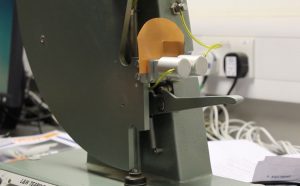
The Process: One half of the specimen is secured in a stationary clamp, while the other is fixed to a movable pendulum. When the pendulum is released, it exerts a shearing force perpendicular to the material surface.
-
The Specimen: Testing typically involves a pack of four sheets of the same material direction, torn simultaneously to ensure statistical accuracy.
-
The Result: The mean force required to propagate the tear is recorded in millinewtons (mN).
Have a question?
Speak to our specialists
Tear Resistance Testing FAQs
What is tear resistance in plastics?
It is the force required to initiate and/or propagate a tear through a material.
What is the difference between tensile strength and tear resistance?
Tensile strength measures resistance to pulling, while tear resistance measures how well a material resists the growth of a cut or tear.
What is the Elmendorf tear test?
A high-speed pendulum test used to measure tear resistance in plastic films.