ISO 14852 – Determination of Aerobic Biodegradability of Plastics in Aqueous Media (CO₂ Evolution Method)
ISO 14852 aerobic biodegradability testing provides that proof. It delivers quantitative data on how plastics biodegrade in water-based environments, helping manufacturers validate environmental performance, meet compliance requirements, and build trust in their products.
Sustainability claims around "biodegradable" plastics are under increasing scrutiny. Regulators, customers, and certification bodies expect clear, measurable proof that materials truly break down under defined environmental conditions.
What ISO 14852 Testing Involves
ISO 14852 specifies a laboratory method for determining the aerobic biodegradability of plastics in an aqueous medium by measuring the amount of carbon dioxide (CO₂) released as microorganisms metabolise the material.
The test assesses:
- The extent and rate of biodegradation
- Microbial breakdown of polymers and additives
- Material performance compared to a reference substance
- Environmental suitability for water-based exposure scenarios
It is widely used for evaluating plastics intended for freshwater, wastewater, and controlled aquatic environments.
Methodology
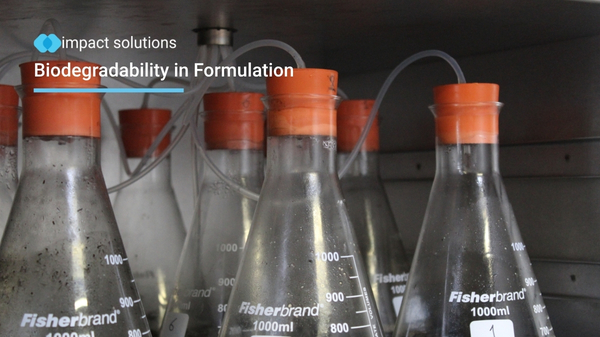
At Impact Solutions, ISO 14852 testing is performed in controlled respirometric systems designed to ensure accuracy, repeatability, and full compliance with the standard.
A typical ISO 14852 programme includes:
- Preparation of plastic samples to defined size and surface area.
- Inoculation with activated sludge or defined microbial cultures.
- Incubation under aerobic conditions in an aqueous medium at controlled temperature.
- Continuous measurement of CO₂ evolution (oxygen consumed) over the test period.
- Comparison against a reference material to validate microbial activity.
- Data analysis and reporting, expressing biodegradation as a percentage of theoretical CO₂.
Testing commonly runs for 28 to 180 days, depending on material type and degradation behaviour.
Relevant Industry Applications
ISO 14852 testing is used across a wide range of applications, including:
- Biodegradable and bio-based plastics
- Water-soluble and dispersible polymers
- Packaging materials
- Agricultural and horticultural products
- Additives, masterbatches, and plastic compounds
- Material research and formulation development
Benefits of AS 5810 Testing
- Provides quantitative, reproducible biodegradation data
- Supports regulatory compliance and certification schemes
- Helps substantiate environmental and sustainability claims
- Enables material and formulation comparison
- Reduces the risk of misleading or unsupported claims
- Builds confidence with regulators, customers, and stakeholders
FAQ
Q: What's the difference between ISO 14852 and ISO 14851?
ISO 14852 measures CO₂ evolution, while ISO 14851 measures oxygen demand. Both assess aerobic biodegradation in aqueous media using different analytical approaches.
Q: Does ISO 14852 prove compostability?
No, it evaluates biodegradation in water-based environments, not composting conditions.
Q: Can finished products be tested?
Yes, but testing should represent the final formulation, including additives and colourants.