Lap Shear Testing | ISO 4587 & ASTM D5868
Adhesively bonded joints are increasingly used in place of, or alongside, traditional mechanical fastening methods. The strength and reliability of these joints can be critical to product performance, particularly where bonded components are subjected to mechanical loading throughout their service life.
Variations in adhesive formulation, substrate material, surface preparation, bond-line thickness, curing conditions and manufacturing processes can significantly influence joint performance. Poor adhesion or inadequate joint strength can result in separation, reduced structural integrity and premature product failure.
Lap shear testing provides a controlled method of evaluating the strength of adhesive bonds under tensile loading. Testing to ISO 4587 and ASTM D5868 enables manufacturers and material developers to quantify joint performance, compare adhesive systems and support material selection, product development and quality assurance.
What Lap Shear Testing Involves
Lap shear testing evaluates the strength of an adhesively bonded joint by applying a tensile force to overlapping bonded substrates until failure occurs.
ISO 4587 specifies a method for determining the tensile lap-shear strength of rigid-to-rigid bonded assemblies using a standard specimen.
ASTM D5868 specifically addresses the lap shear adhesion of fibre-reinforced plastics (FRP) bonded to themselves and is particularly relevant to composite material applications.
Depending on the applicable standard and material system, testing can be performed on:
- Metals
- Rigid plastics
- Fibre-reinforced plastics
- Composite materials
- Engineering polymers
- Adhesively bonded panels
- Coated or surface-treated substrates
- Structural adhesive systems
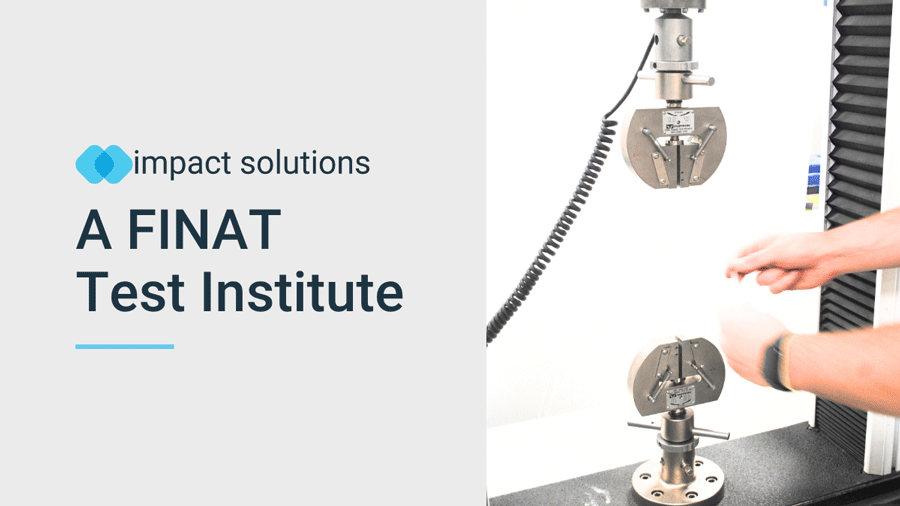
During testing, the bonded specimen is secured within a tensile testing machine and loaded at a controlled rate. The force is transferred through the overlap region until the adhesive joint or substrate fails.
Testing can provide information including:
- Lap shear strength
- Maximum failure load
- Apparent shear strength
- Bond consistency
- Adhesive failure
- Cohesive failure
- Substrate failure
- Comparative adhesive performance
Assessment of both the measured strength and the resulting failure mode provides valuable information about the performance of the complete adhesive and substrate system.
Methodology
At Impact Solutions, lap shear testing is carried out using calibrated mechanical testing equipment in accordance with ISO 4587 or ASTM D5868, depending on the material and application.
A typical testing programme includes:
- Identification of the appropriate test standard for the adhesive and substrate system.
- Preparation of representative substrates and bonded lap shear specimens.
- Control of relevant specimen parameters, including overlap dimensions and bond-line preparation.
- Conditioning or curing of specimens under the specified conditions.
- Measurement and inspection of specimens prior to testing.
- Installation and alignment of the specimen within a calibrated tensile testing machine.
- Application of tensile loading at the specified test rate until failure occurs.
- Recording of the maximum force sustained by the bonded joint.
- Calculation of the required lap shear strength and assessment of the failure mode.
- Comprehensive reporting of test conditions, individual results and observations.
Testing is performed under controlled laboratory conditions to provide accurate, repeatable and reliable adhesive joint performance data.
Relevant Industry Applications
Lap shear testing is widely applicable to:
- Structural adhesives
- Automotive components
- Aerospace materials
- Fibre-reinforced composites
- Engineering plastics
- Metal bonding
- Construction products
- Transportation applications
- Marine components
- Industrial assemblies
- Adhesive development
- Surface treatment evaluation
- Product design and validation
- Manufacturing quality assurance
Benefits of Lap Shear Testing
- Quantifies the strength of adhesively bonded joints
- Enables comparison between alternative adhesive systems
- Evaluates the influence of substrate preparation and surface treatment
- Supports adhesive selection during product development
- Assesses the performance of bonded composite materials
- Identifies adhesive, cohesive and substrate failure
- Supports optimisation of curing and manufacturing processes
- Provides quantitative data for engineering and technical documentation
- Supports quality assurance and failure investigations
- Uses recognised ISO and ASTM test methods
Need to determine the lap shear strength of your adhesive joints?
Contact Impact Solutions to discuss lap shear testing to ISO 4587 and ASTM D5868 and obtain reliable mechanical performance data for your adhesives, substrates and bonded assemblies.
FAQ
Q: What is a lap shear test?
A lap shear test evaluates the strength of an adhesive bond between two overlapping substrates. The bonded specimen is subjected to tensile loading until failure, allowing the strength and failure behaviour of the joint to be assessed.
Q: What is the difference between ISO 4587 and ASTM D5868?
ISO 4587 is used to determine the tensile lap-shear strength of rigid-to-rigid bonded assemblies. ASTM D5868 is specifically intended for determining the lap shear adhesion of fibre-reinforced plastics bonded to themselves. The appropriate method therefore depends on the substrates and adhesive system being evaluated.
Q: What materials can be tested?
Depending on the applicable standard, lap shear testing can be performed on adhesively bonded metals, rigid plastics, fibre-reinforced plastics, composites and other suitable rigid substrates.
Q: What does the failure mode tell you?
Failure mode can help identify the weakest part of the bonded system. Adhesive failure occurs at the adhesive-substrate interface, cohesive failure occurs within the adhesive itself, and substrate failure occurs within the material being bonded. This information can be valuable when developing or optimising adhesive systems.
Q: Can lap shear testing be used to compare different adhesives?
Yes. When specimens are prepared and tested under equivalent conditions, lap shear testing can provide useful comparative data for different adhesives, surface treatments, substrates, curing conditions and manufacturing processes.