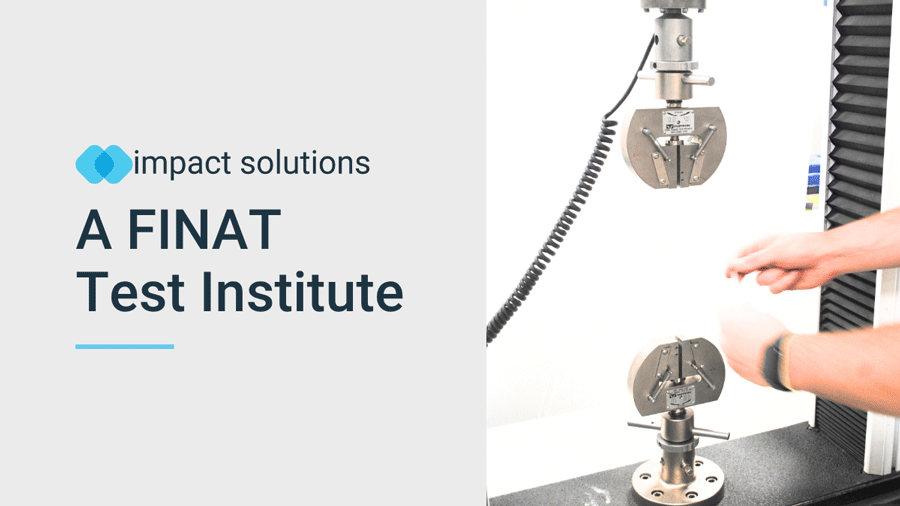
Young’s Modulus Testing
Understanding the stiffness and mechanical behaviour of materials is critical during product development, quality control and material selection. Selecting a material with insufficient stiffness can result in excessive deformation, reduced product performance, premature failure and increased manufacturing costs.
Manufacturers supplying components into highly regulated industries often need to demonstrate compliance with recognised mechanical testing standards before products can be approved or brought to market. Reliable Young’s Modulus testing provides the data needed to validate material performance, compare alternative materials and support engineering design decisions.
Young’s Modulus testing in accordance with ISO 527-1, ISO 527-2 and ASTM D638 enables manufacturers to accurately determine the elastic modulus of plastics and polymer materials, providing confidence in product performance and supporting customer and regulatory requirements.
What Young’s Modulus Testing Involves
Young’s Modulus, also known as the modulus of elasticity, measures a material’s stiffness by determining the relationship between applied stress and resulting strain within the elastic region of the material.
Testing is commonly performed in accordance with internationally recognised standards including:
- ISO 527-1 – Plastics – Determination of tensile properties – General principles
- ISO 527-2 – Plastics – Determination of tensile properties of moulding and extrusion plastics
- ASTM D638 – Standard Test Method for Tensile Properties of Plastics
Testing may be carried out on a wide range of materials including:
- Thermoplastics
- Thermosetting plastics
- Engineering polymers
- Composite materials
- Polymer compounds
- Filled and reinforced plastics
In addition to Young’s Modulus, tensile testing can also determine:
- Tensile strength
- Yield strength
- Elongation at yield
- Elongation at break
- Stress-strain behaviour
- Tensile strain at specified loads
These results provide valuable information about how materials will perform under service conditions and support informed material selection during product development.
Methodology
At Impact Solutions, Young’s Modulus testing is performed using calibrated universal testing equipment in accordance with ISO 527-1, ISO 527-2 and ASTM D638.
A typical testing programme includes:
- Preparation of representative test specimens in accordance with the applicable standard.
- Conditioning of specimens under controlled environmental conditions where required.
- Measurement of specimen dimensions prior to testing.
- Installation of specimens within a calibrated universal testing machine.
- Application of tensile loading at the specified test speed.
- Continuous measurement of load and extension using calibrated extensometry where appropriate.
- Calculation of Young’s Modulus from the initial linear portion of the stress-strain curve.
- Comprehensive reporting of mechanical properties, test conditions and observations.
Testing is performed under carefully controlled laboratory conditions to ensure accurate, repeatable and reliable results.
Relevant Industry Applications
Young’s Modulus testing is widely used for:
- Automotive components
- Aerospace materials
- Medical devices
- Consumer products
- Packaging materials
- Construction products
- Electrical and electronic components
- Polymer material development
- Research and development
- Quality assurance programmes
Benefits of Young’s Modulus Testing
- Accurately determines material stiffness
- Supports engineering design and structural calculations
- Assists with material selection during product development
- Demonstrates compliance with recognised international standards
- Enables comparison of different material grades
- Supports product quality assurance
- Provides reliable mechanical property data for technical documentation
- Helps identify material performance before products reach the market
Need reliable Young’s Modulus data for your materials?
Contact Impact Solutions to discuss Young’s Modulus testing in accordance with ISO 527-1, ISO 527-2 and ASTM D638 and ensure your materials meet recognised mechanical performance requirements.
FAQ
Q: What is Young’s Modulus?
Young’s Modulus is a measure of a material’s stiffness. It describes how much a material deforms when subjected to an applied force within its elastic range and is one of the most important mechanical properties used in engineering design.
Q: Which standards are commonly used for Young’s Modulus testing?
Young’s Modulus testing for plastics is commonly carried out in accordance with ISO 527-1, ISO 527-2 and ASTM D638. The most appropriate standard depends on the material type and customer or regulatory requirements.
Q: What materials can be tested?
A wide variety of plastic materials can be evaluated, including thermoplastics, thermosetting plastics, engineering polymers, composites and reinforced materials.
Q: What information does the test provide?
In addition to Young’s Modulus, tensile testing can provide tensile strength, yield strength, elongation at yield, elongation at break and complete stress-strain data, helping engineers understand how materials will perform in service.