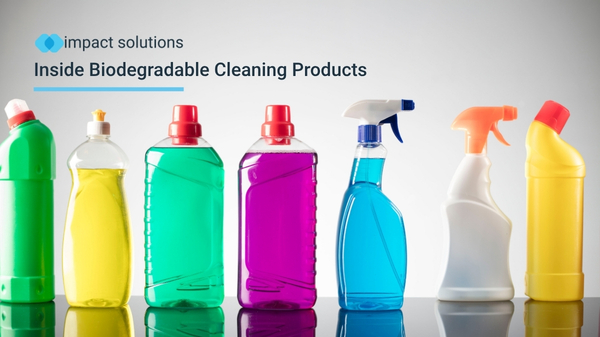
When people see "biodegradable" on a cleaning product label, it is often taken as a simple reassurance that the product is environmentally harmless. In reality, biodegradability depends entirely on what is inside the formulation. Household cleaning products are complex chemical mixtures, and their environmental impact is shaped ingredient by ingredient.
Understanding what those ingredients are, and how they behave once they go down the drain, is essential for assessing whether a product is genuinely sustainable or simply marketed that way.
Why ingredients matter in cleaning product biodegradability
Household cleaning products are designed to perform in a very specific way. They must remove grease, kill microbes, dissolve dirt and remain stable on the shelf. To achieve this, manufacturers combine multiple functional ingredients, each with a different role.
However, once these products enter wastewater systems, lakes or soil, those same ingredients behave very differently. Some break down quickly into harmless substances, while others may persist for much longer and accumulate in the environment.
This is why biodegradability cannot be assessed at product level alone. It must be understood at the level of individual chemical components.
Surfactants: the core cleaning agents
Surfactants are the primary active ingredients in most household cleaning products, including washing-up liquids, laundry detergents and all-purpose cleaners. Their role is to break down grease and lift dirt from surfaces so it can be washed away with water.
Chemically, surfactants have a dual structure:
- A hydrophilic (water-attracting) head
- A hydrophobic (oil-attracting) tail
This allows them to surround and emulsify oils and fats, forming structures called micelles that can be rinsed away.
From a biodegradability perspective, surfactants are often the most environmentally important ingredient group. Many modern surfactants, such as alcohol ethoxylates, are classified as readily biodegradable. This means they can be broken down by microorganisms under standard environmental conditions within a relatively short period.
However, not all surfactants perform equally well. Some, particularly older synthetic variants or certain quaternary ammonium compounds, degrade more slowly and may be more toxic to aquatic life. This makes surfactant selection one of the most important decisions in sustainable cleaning product formulation.
Preservatives and disinfectants: protecting the product, but affecting breakdown
Preservatives and disinfectants are added to cleaning products to prevent microbial growth and maintain shelf life. In antibacterial sprays, surface cleaners and wipes, these ingredients are also responsible for killing bacteria on contact.
Common examples include quaternary ammonium compounds and certain alcohol-based systems.
While effective for hygiene, these ingredients can complicate biodegradability. Because they are designed to inhibit microbial activity, they may also reduce the efficiency of microbial breakdown once released into wastewater environments. In some cases, they can slow down the natural processes that would otherwise degrade the product.
There is also an important balance to consider. The more biocidal a product is, the more likely it is to interfere with the very microorganisms that are responsible for environmental degradation.
Fragrances, dyes and minor additives
Fragrances and dyes are often included in cleaning products to improve consumer experience rather than performance. Despite typically being present in small quantities, they can still play a role in environmental persistence.
Fragrance compounds are particularly complex. They are made up of multiple organic molecules, some of which biodegrade easily, while others are more resistant. Because fragrance blends are often proprietary, it can be difficult to assess their full environmental profile.
Dyes and optical brighteners are another category of concern. These are designed to remain stable during use, which can also make them slower to break down after disposal.
Although these ingredients are not the primary drivers of cleaning performance, they contribute to the overall biodegradability profile of the product.
Solvents and stabilisers: supporting ingredients with hidden impact
Solvents are used in cleaning products to dissolve active ingredients and ensure a consistent formulation. Water is the most common solvent, but others such as glycols or alcohols are also used.
Many solvents are readily biodegradable, but this is not universal. Some stabilisers and chelating agents, which are used to improve product performance in hard water, can persist longer in the environment.
These supporting ingredients are often overlooked, yet they can significantly influence how a product behaves after use.
How rapid biodegradation screening can help
A key challenge in cleaning product development is identifying which ingredient, or combination of ingredients, is limiting biodegradability within the final formulation.
Traditional biodegradability testing can be time-consuming, particularly when manufacturers are reformulating products or comparing multiple ingredient combinations. In many cases, individual raw materials may appear biodegradable in isolation, but the complete formulation performs very differently once ingredients interact.
This is where rapid biodegradation screening can provide significant value.
By screening formulations early in development, manufacturers can quickly identify which components are hindering biodegradation performance. For example, a surfactant system may degrade efficiently on its own, but when combined with a particular preservative or fragrance blend, the overall biodegradation rate may fall substantially.
Rapid screening allows formulators to:
- Compare alternative ingredient systems quickly
- Identify problematic additives earlier in development
- Optimise formulations before full-scale testing
- Reduce reformulation time and cost
- Improve confidence in environmental claims
This approach also supports more targeted product development. Rather than reformulating an entire cleaning product unnecessarily, manufacturers can focus on the specific ingredient groups responsible for poor biodegradation performance.
As sustainability expectations continue to increase across the household cleaning sector, rapid screening tools can help companies develop products that balance cleaning efficacy, stability and environmental compatibility more efficiently.
What this means for sustainable cleaning products
The biodegradability of household cleaning products is not determined by a single ingredient or marketing claim. It is the result of how surfactants, preservatives, fragrances and supporting chemicals interact as a complete system.
For manufacturers, this means that designing environmentally responsible cleaning products requires careful ingredient selection and robust testing of the final formulation. Rapid biodegradation screening can play an important role in this process by helping identify the specific formulation components that are limiting environmental performance.
For consumers, it highlights the importance of looking beyond labels such as "eco-friendly" or "plant-based" and considering whether meaningful biodegradability data is provided.
Ultimately, the most sustainable cleaning products are not just those that clean effectively, but those designed to break down safely and efficiently once their job is done.
Visit Impact-Bio® for more information on how rapid biodegradation screening can assist your business in its product development cycle.