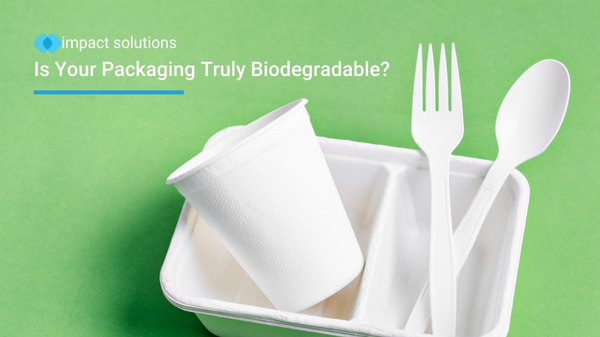
As sustainability becomes a core expectation rather than a nice-to-have, more packaging is being labelled “biodegradable”. But a critical question remains for brands, manufacturers and packaging developers:
Is your packaging truly biodegradable, or does it just claim to be?
Without credible testing, it’s surprisingly difficult to know the answer. In this article, we explore what biodegradability really means for packaging, the risks of unverified claims, and how comprehensive testing services like Impact-Bio® can help you make confident, evidence-based decisions.
What Does “Biodegradable Packaging” Actually Mean?
Biodegradable packaging is designed to break down through natural biological processes, using microorganisms such as bacteria and fungi. However, biodegradation is not a single, universal process.
A packaging material may only biodegrade:
- Under specific temperatures
- In high-moisture environments
- In soil, freshwater or marine conditions
- Over a long, undefined timeframe
This means that a product labelled “biodegradable” might perform very differently depending on where it ends up after use.
Why Biodegradability Claims Can Be Misleading
One of the biggest challenges with biodegradable packaging is that the term itself is often used too loosely.
Without testing:
- There is no guarantee the material will break down as expected
- Biodegradation may take years rather than months
- The material may only degrade under industrial conditions
- Claims may not align with regulatory expectations
As a result, businesses risk making sustainability claims that are inaccurate (even unintentionally) which can lead to reputational damage, loss of customer trust, or accusations of greenwashing.
Biodegradable, Compostable or Recyclable: Does It Matter?
Absolutely.
Many packaging materials fall into overlapping or misunderstood categories:
- Biodegradable materials may break down naturally, but not necessarily in composting systems
- Compostable materials must meet specific standards and conditions
- Recyclable materials are designed to be reprocessed, not biodegraded
Choosing the wrong end-of-life pathway can result in packaging that performs poorly or contaminates waste streams. That’s why understanding actual material behaviour, not just marketing labels, is essential.
The Role of Testing in Packaging Development
Credible biodegradability testing removes uncertainty.
By generating data on how a packaging material behaves under controlled conditions, testing allows organisations to:
- Validate biodegradability claims
- Compare materials early in development
- Reduce the risk of non-compliance
- Support transparent sustainability communication
However, traditional biodegradability testing can be time-consuming and costly — particularly during early-stage R&D.
How Impact-Bio® Supports Smarter Decisions
Impact-Bio® is Impact Solutions’ new Comprehensive Biodegradability Testing capability, designed to give early insights into how packaging materials break down.
Impact-Bio® helps organisations:
- Identify biodegradation potential earlier
- Screen multiple materials quickly
- Reduce development risk
- Focus full certification testing where it matters most
Rather than relying on assumptions, Impact-Bio® provides evidence to guide packaging choices and sustainability strategies.
Ask Yourself These Key Questions
Before making biodegradability claims, consider:
- Under what conditions does my packaging biodegrade?
- How long does degradation take?
- Is this supported by scientific data?
- Does the claim align with how customers will dispose of the packaging?
If you can’t confidently answer these questions, testing is the next step.
Is Your Packaging Truly Biodegradable?
Accurate biodegradability claims rely on clear evidence, robust data and a sound understanding of material behaviour.
If you are developing or using packaging labelled as biodegradable, Impact-Bio® provides early insight into how materials perform, helping to identify risks, support credible claims and guide informed decisions throughout development.
Contact Impact Solutions today to discuss your packaging and testing requirements.
Don’t forget to follow us on LinkedIn, Facebook, and Instagram for more service updates and industry news.
FAQ
Can packaging be labelled biodegradable without testing?
While claims are sometimes made without testing, this carries significant risk. Credible testing provides the evidence needed to support accurate, defensible claims.
Are bioplastic packaging materials always biodegradable?
No. Many bioplastics are bio-based but behave like conventional plastics. Testing is required to determine actual biodegradation performance.
When should biodegradability testing be carried out?
Ideally during early-stage development. Rapid screening tools, offered by Impact-Bio®, allow issues to be identified before full-scale production or market launch.